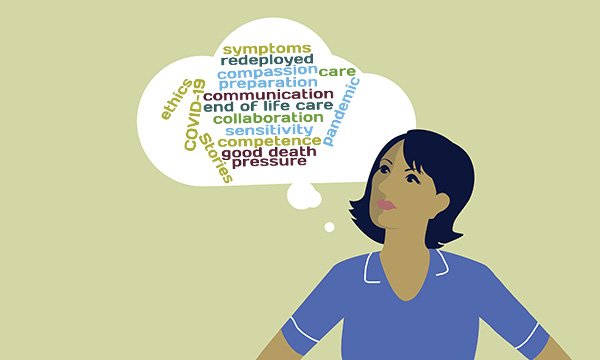
Redeployed staff learn about communication skills and their roles as witness bearers

Young people who have learning disabilities commonly have many complex and severe life-limiting conditions that result in premature death. Too often neither they nor their family and friends are prepared for end of life situations. End of life care planning is helpful in eliciting and honouring the young person’s wishes, as far as possible. However, it can be challenging due to communication difficulties and limited understanding of the meaning of death and dying.
This article introduces the ADVANCE toolkit featuring a values-based framework that aims to help caregivers who work with young people who have learning disabilities, including nurses, social workers and care assistants, develop their confidence and skills in end of life care planning. The ADVANCE toolkit enables insight in knowing how, when and with whom to discuss the sensitive topic of planning for end of life care. In this article, six activities are included for readers to complete with a view to enabling engagement with the material presented.

To develop, implement and evaluate a collaborative intervention in care homes seeking to increase the confidence and competence of staff in end of life care and enable more people to receive end of life care in their usual place of residence.
A two-phase exploratory mixed methods design was used, evaluating the effect of an end of life care toolkit and associated training in care homes, facilitated by a specialist palliative care team. Six care homes in England were recruited to the intervention; 24 staff participated in discussion groups; 54 staff attended at least one training session; and pre- and post-intervention questionnaires were completed by 78 and 103 staff respectively.
Staff confidence in receiving emotional and clinical support and managing end of life care symptoms increased post-intervention, but confidence in discussing death and dying with residents and relatives decreased. Audit data indicate greater reduction in the number of residents from participating care homes dying in hospital than those from comparison homes.
Collaborative end of life care interventions support care home staff to manage end of life and may enable residents to have choice about their place of death.
<p>Maintaining patient dignity is an important aspect of nursing care. However, the behaviour of nurses and other healthcare professionals may affect delivery of dignified care. An educational initiative, developed for a UK dignity campaign, incorporated visual metaphors to prompt nurses’ reflection and raise their awareness of behaviour that can compromise patient dignity. During a qualitative evaluation of the campaign’s progress at seven healthcare organisations, interviews were carried out with 51 staff with local leadership roles in the campaign. This article reports on their perceptions of the effect of the visual metaphors on nursing staff. Three sub-themes emerged: challenging staff defensiveness about their practice, recognising practice that compromises patient dignity, and questioning everyday practice in the care environment. The use of visual metaphors stimulated reflection among staff regarding their contribution to enhancing or diminishing patient dignity. There is a need for further research in this area to examine subsequent changes in practice and their sustainability in relation to promoting and maintaining dignity in care.</p>
<p>This article discusses ethical aspects of ‘terminal sedation’ in relation to end-of-life care. An examination of the literature reveals there are different definitions and explanations of terminal sedation. Some definitions appear compatible with the values of palliative care and nursing, whereas others could arguably be perceived as deserving of the term ‘euthanasia in disguise’. The authors suggest that ‘palliative sedation’ is a more helpful term and argue that, when defined and understood appropriately, it is a defensible and ethical practice. Nurses should be clear about the purpose of their profession, honest about their intentions and respect the autonomy and dignity of the patients for whom they provide care. The doctrine or principle of ‘double effect’ has been put forward to support the practice of terminal sedation. The authors examine this doctrine and caution that nurses and other professions need to approach it critically in relation to terminal sedation. Vignettes are used to illustrate aspects of the discussion.</p>
This article discusses ethical aspects of ‘terminal sedation’ in relation to end-of-life care. An examination of the literature reveals there are different definitions and explanations of terminal sedation. Some definitions appear compatible with the values of palliative care and nursing, whereas others could arguably be perceived as deserving of the term ‘euthanasia in disguise’. The authors suggest that ‘palliative sedation’ is a more helpful term and argue that, when defined and understood appropriately, it is a defensible and ethical practice. Nurses should be clear about the purpose of their profession, honest about their intentions and respect the autonomy and dignity of the patients for whom they provide care. The doctrine or principle of ‘double effect’ has been put forward to support the practice of terminal sedation. The authors examine this doctrine and caution that nurses and other professions need to approach it critically in relation to terminal sedation. Vignettes are used to illustrate aspects of the discussion.